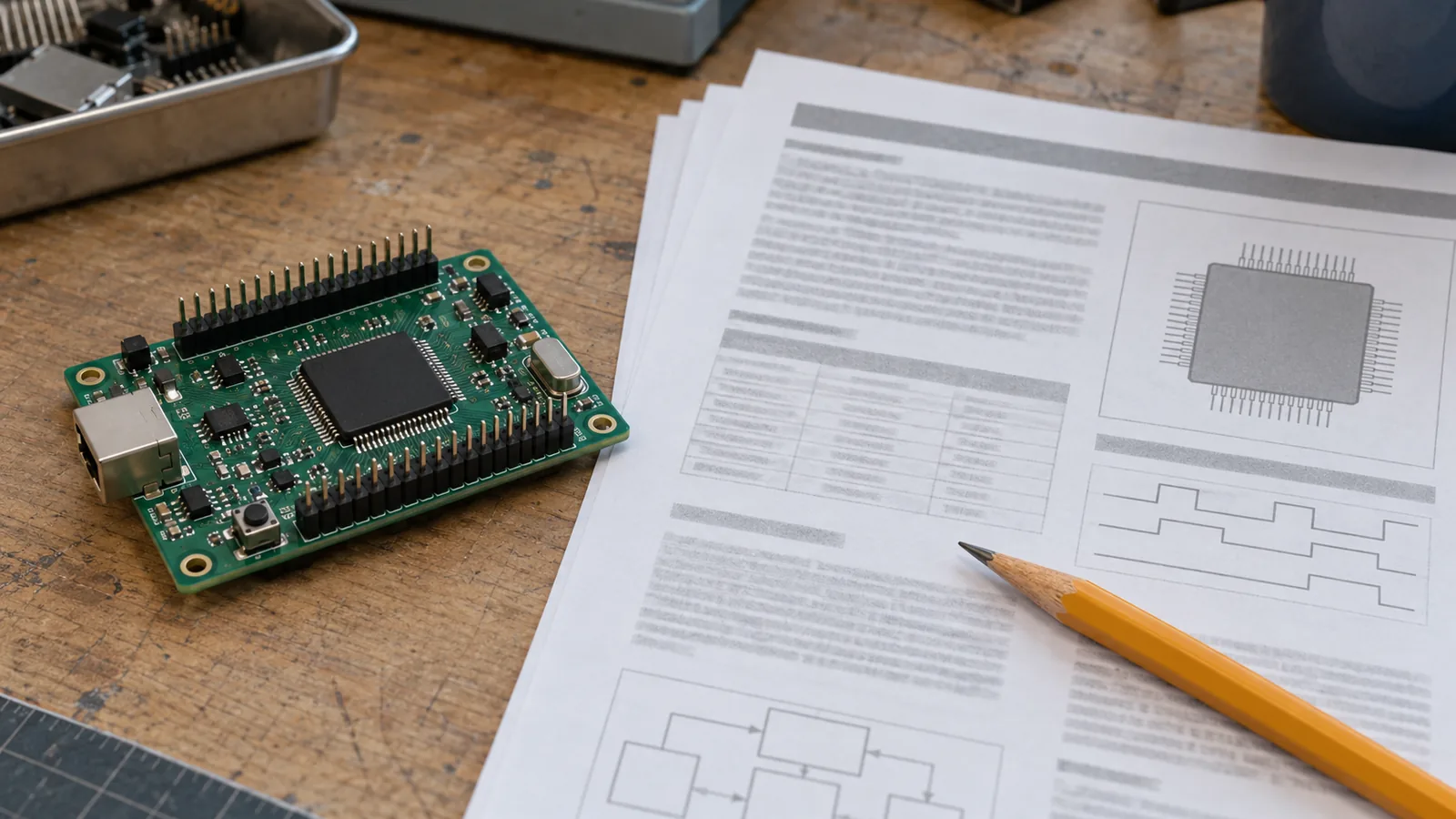
A microcontroller specification copied without its conditions can create a wrong design assumption. Read the exact device and package document first, then record each value with its section, operating conditions, footnotes and any required companion document.
This checklist is for readers learning component documentation, including purchasing staff who need to preserve engineering requirements accurately. It produces a condition record rather than firmware instructions or a recommendation to purchase an old MCU.

| Input or item | Typical value or source | Why it matters |
|---|---|---|
| Device and package | Full ordering code and matching datasheet | Sets the document scope |
| Document revision | Front page and revision history | Identifies the evidence used |
| Operating limits | Recommended operating-condition section | Separates operation from stress limits |
| Electrical value | Table row, heading and footnote | Preserves the meaning of the number |
| Functional behavior | Relevant user/reference manual | Supplies information beyond a summary table |
| Unresolved condition | Engineering question with document owner | Prevents an assumption being approved silently |
Identify the document before reading its numbers
Confirm the manufacturer, exact part, package and revision before transferring a specification into a requirement. A document with a similar family name is not sufficient to identify the variant being reviewed.
The full part identifier belongs beside the document title. Record the publication or revision date stated in the file, the source URL and the section being used. Retain the original document in the project records according to the organization’s document policy. A web link alone can later lead to a revised file.
The examples here are historical: TI’s Stellaris LM3S611 datasheet is dated July 14, 2014, and the DS2251T microcontroller-module file is legacy Maxim documentation now hosted by Analog Devices. They demonstrate how to read documents. Neither is presented as a current purchasing choice. For identity questions, use the ordering-code and marking record before interpreting specifications.
Takeaway: Every extracted condition starts with an exact document and device identity.
Separate stress limits from operating conditions
Absolute maximum ratings describe stress boundaries; use the stated operating sections for the intended operating conditions. Do not turn the largest published limit into a design target.
The DS2251T absolute-maximum section on page 9 describes its ratings as stress limits and does not imply functional operation at those conditions. The LM3S611 electrical-characteristics sections 18.1.1 and 18.1.2 (page 531) likewise states that proper operation at maximum ratings is not guaranteed, then supplies a separate recommended DC operating-condition table. The distinction is explicit in the original files.
| Section label | Question it helps answer | What to record |
|---|---|---|
| Absolute maximum / maximum ratings | What stress limits does this file state? | Section and warning, kept separate from operating requirements |
| Recommended operating conditions | Under what stated conditions is the device intended to operate? | Relevant row and applicable notes |
| Electrical characteristics | What behavior is specified under which conditions? | Min/typ/max label, unit and test conditions |
| Typical characteristics | What example behavior is illustrated? | Figure conditions and its status as typical data |
Read these categories in the device’s own terminology. The article does not translate them into a universal approval rule. The power documentation route helps keep supply requirements connected to the equipment documents that apply above component level.
Common mistake: Copying an absolute-maximum supply limit into a field labeled “normal operating supply.”
Takeaway: Keep stress boundaries and intended operating conditions in separate records.
Copy the conditions with the value
An electrical value is usable only with its definition, unit and stated conditions. Record the heading and notes even when the number itself appears straightforward.
For a current-consumption entry, capture the operating mode, clock conditions, supply, temperature and enabled functions where the source states them. For a timing entry, capture the signals and reference conditions defined by the source. Missing information remains a question for the document owner; it is not an invitation to infer a worst case from a typical plot.
| Field | Entry to preserve | Review question |
|---|---|---|
| Parameter | Exact symbol and plain-language meaning | Does the requirement use the same definition? |
| Published value | Value, unit and min/typ/max column | Is this a limit or typical behavior? |
| Conditions | Row conditions, heading and relevant notes | Does the intended use match them? |
| Device scope | Part, package and document revision | Is the requirement for this variant? |
| Location | Section, table or figure | Can another reader find the same entry? |
| Source identity | Title, identifier, revision and URL | Which exact file supports the entry? |
| Intended use | Actual project conditions from its own record | How do they differ from the source conditions? |
| Review status | Supported comparison or unresolved difference | What still needs review? |
| Companion document | Named required file and applicable version | Which question does it answer? |
| Remaining question | Specific missing condition and named owner | What evidence resolves it? |
This condition record supports embedded control documentation when an interface requirement depends on MCU configuration. It also supports sourcing review: a purchasing comparison should retain the engineering conditions rather than comparing isolated headline numbers.
Takeaway: Transfer the parameter’s meaning and conditions together with its value.
Follow the document split for functional behavior
Use the datasheet for the information it actually contains, and follow its references when behavior belongs in another manual. File names alone do not define a universal division of content.
The DS2251T description directs operating information to the Secure Microcontroller User’s Guide while identifying ordering information, pinout and electrical specifications as datasheet content. The much longer LM3S611 datasheet includes functional chapters as well as electrical and package information. These examples show why a checklist should track the required document rather than assume all manufacturers divide their files identically.
Locate, follow or hand over: Current file answers · Companion file needed · Conditions unresolved · Responsible engineer.
The chapter-to-task matrix below uses the historical LM3S611 file to show a reading path, with the DS2251T module’s document split as a second example. The fields are editorial recommendations, not required wiring or firmware steps.
| Task | Example source location | Record and conditions | Companion document question |
|---|---|---|---|
| Identify package and pins | LM3S611 chapter 15 Pin Diagram; DS2251T pages 4–6 | Package, physical pin and source-defined signal name | Does the actual assembly drawing identify the same package? |
| Understand signal function | LM3S611 chapter 16 Signal Tables | Signal function and source-defined multiplexing conditions | Which device functional section or reference manual answers the use question? |
| Record intended operation | LM3S611 section 18.1.2 | Operating-condition row and applicable notes | Do the actual project conditions match? |
| Record power conditions | LM3S611 section 18.1.5; DS2251T DC Characteristics | Mode, clock and other stated conditions with the value | Which configuration record supplies intended use? |
| Locate functional behavior | DS2251T Description, page 2; LM3S611 functional chapters | The question and the file that answers it | DS2251T directs operating information to the Secure Microcontroller User’s Guide |
The pin record preserves package, physical pin, signal name and functional conditions separately. It supplies no pin assignment for an unknown MCU. Where the current file answers the question, preserve its source location. Where a companion file is needed, name that file and its applicable version. If either the evidence or the condition match remains unresolved, record the question and hand it to the responsible engineer.
For the actual device, note whether a reference manual, user guide, errata or application-specific document is needed and where the manufacturer directs the reader. Finding a register name does not complete a board-level interface review. The control-interface route is a separate task for the surrounding connection and application requirements.
Use the industrial application route to preserve the equipment configuration above the MCU. If the project is considering another part, begin a separate sourcing review rather than rewriting the original condition record to fit a candidate.
Takeaway: Record which document answers each question; do not assume the datasheet contains every answer.
When this does not apply
This checklist does not approve a design, validate firmware or certify that an operating point is acceptable. It is unsuitable as a substitute for current documentation for the actual device and board.
Historical examples demonstrate reading habits only. A table with all fields filled can still contain conditions that do not match the intended application. Send those differences to the responsible engineer with the source location and the specific unresolved requirement. Leave unknown values blank or explicitly unresolved rather than treating a blank as zero.
Takeaway: A complete condition record supports an engineering decision; it does not make that decision.
Methods and sources
This editorial checklist uses the original TI LM3S611 datasheet, July 2014, and the legacy DS2251T datasheet hosted by Analog Devices, accessed October 8, 2026. The DS2251T module file identifies REV: 061306 and its final revision summary names the June 13, 2006 version; this is a revision date, not a verified first-publication date. We reread the document-description and electrical-rating sections. No numerical MCU performance comparison, device testing or current procurement recommendation is offered.
Related reading
- Ordering codes and package markings — Establish the identity used in the condition record.
- Embedded control — Continue from component conditions to system interface documentation.