A smaller connector chosen on headline current alone can create panel rework. HARTING’s Han Size 4 announcement makes it a candidate for a documented replacement assessment, with electrical, mechanical and sourcing checks still needed before replacing a Han 6 assembly.
Can Han Size 4 replace Han 6? The announcement does not establish an interchangeable replacement. It supports investigating a smaller assembly where the exact inserts, contacts, operating conditions and mounting arrangement meet the project’s requirements. The useful next step is a comparison of complete bills of materials, followed by review of the applicable drawings, ratings and approval documents.
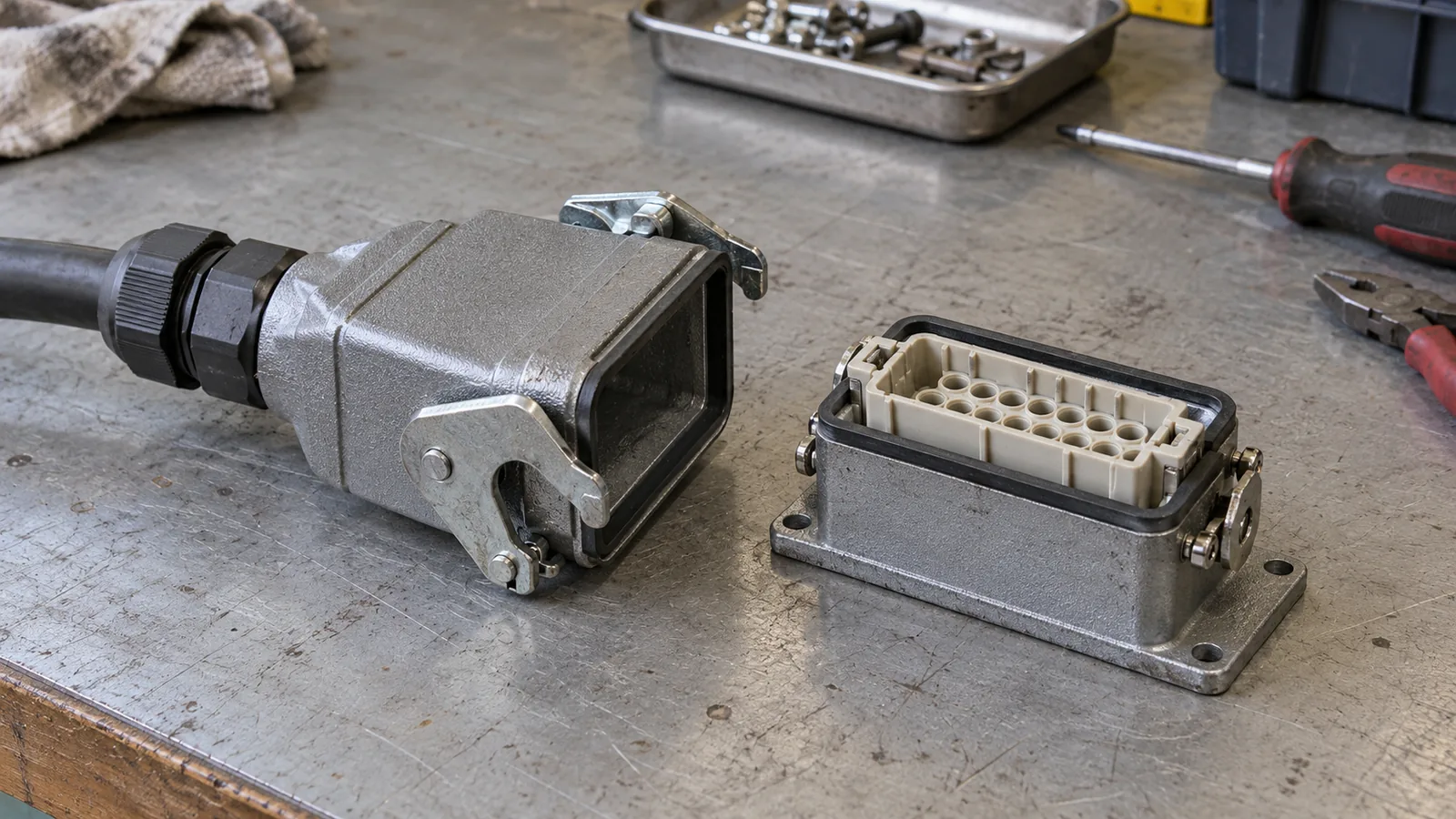
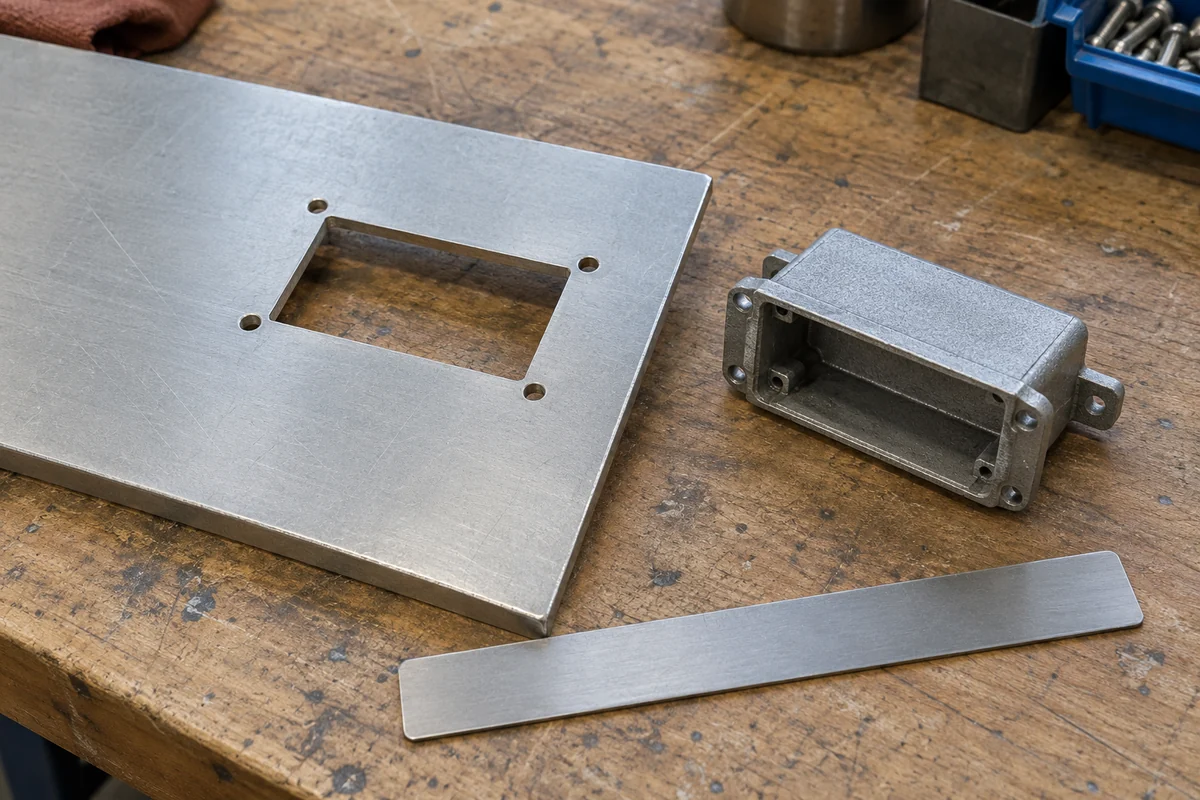
Images show generic objects as examples, not the named product, a supplier facility or a test record.
- Separate the housing size from the electrical insert and contact configuration.
- Keep the published HPR comparisons tied to their stated reference assemblies.
- Record changes to the panel, mating half and cable route together.
- Obtain a dated US supply response for the actual assembly.
The component documentation route provides the broader reading path for identifying a component before interpreting its specifications.
What did HARTING announce, and which comparison belongs to HPR?
HARTING’s September 17, 2026 release introduces Size 4 across Han HPR, Han B and Han-Eco and advertises current capacity up to 70 A. The footprint and weight examples below concern HPR; the announcement is a manufacturer statement, rather than an independent test of a proposed replacement.
| Announcement item | Manufacturer’s stated comparison | How to use it |
|---|---|---|
| Size 4 introduction | Han HPR, Han B and Han-Eco | Identify the actual housing family |
| Current headline | Up to 70 A; compared with Size 6 capability | Obtain the applicable insert/contact rating and conditions |
| Mounting footprint | Han 4 HPR versus Han 6 HPR: 55% smaller | Review the mounting drawings for the proposed assembly |
| Compact comparison | Han 4 HPR versus Han 6 HPR Compact: almost 40% smaller | Keep the reference housing explicit |
| Assembly weight | Han 6 HPR: 530 g; Han 4 HPR: just under 270 g | Applies to the stated M25 straight-entry hood, mounting housing, screw lock and articulated-frame configuration |
All numerical entries in this table come from that release. They describe its comparison, not a guarantee for every assembly. Do not substitute a bare hood’s weight for a complete assembly’s weight or transfer the HPR savings to another family.
The ordering-code and marking guide explains how to keep a family label, complete ordering code and physical marking in separate fields. That distinction matters when a drawing calls for a specific assembly while a purchasing conversation uses only “Han 4.”
Takeaway: Compare the same assembly scope before using the announcement’s savings in a design discussion.
How do you identify the housing without assigning it an insert rating?
Use the complete article number to establish the housing attributes, then identify the electrical parts separately. HARTING’s page for article 19400040410 describes a Han HPR hood of size 4 B with screw locking and M20 top entry. A hood description is not the current rating of a populated connector.
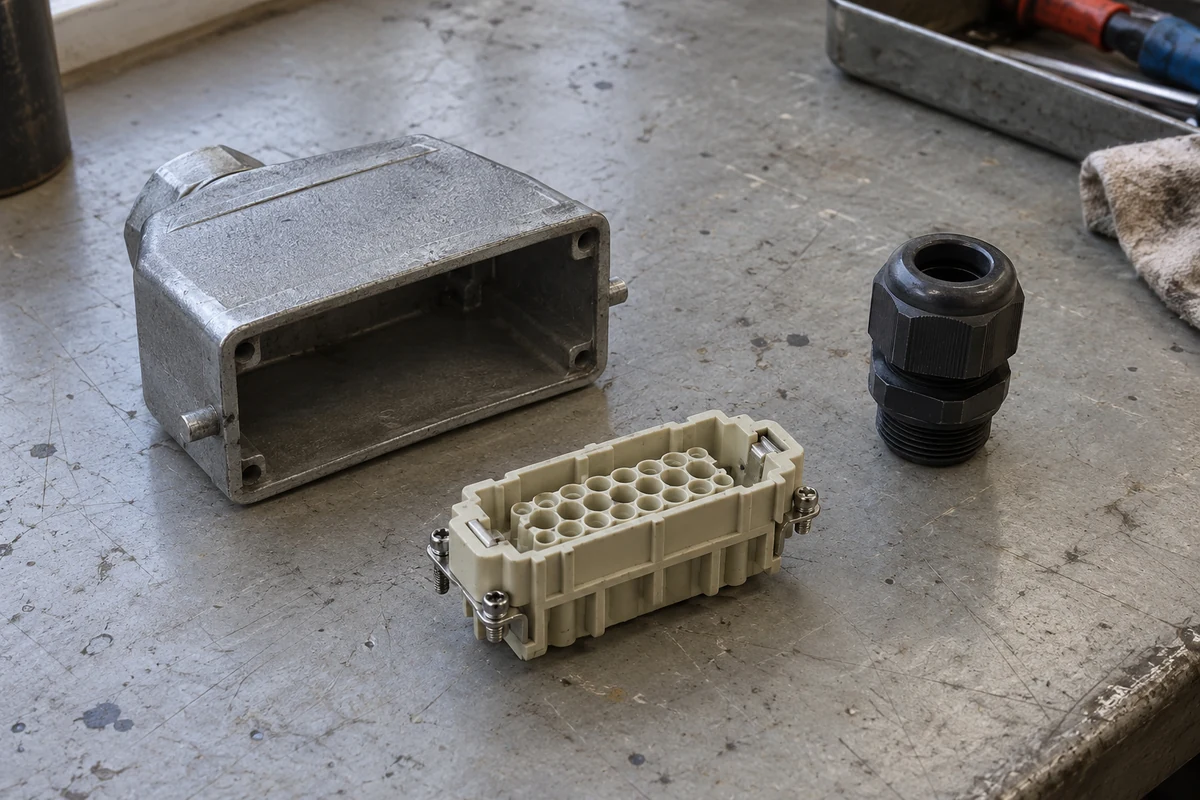
That catalog item also differs from the release’s M25 assembly example. It can illustrate how a housing record is structured; it cannot stand in for the announcement’s complete comparison configuration. Write the hood, base, carrier or frame, inserts, contacts and mating counterpart as separate entries in the candidate record.
Treat “Han 4A” and other names containing a four as distinct identities until their exact ordering documentation establishes what they are. The size designation on the cited hood page is “4 B.” Similar-looking names do not authorize combining their parameters. This article does not assign a rating to an unidentified 4A insert or decode an unknown connector from its appearance.
Use the replacement requirements matrix to compare identities without turning a candidate into an approved substitute. Keep the original assembly’s part list available rather than reconstructing it from a short description.
Takeaway: Identify every part in the proposed mating assembly; a housing size cannot answer the electrical question.
Which differences decide whether the substitution deserves engineering review?
Start with the installed assembly and the project’s requirements, not a target percentage reduction. The assessment below is an editorial comparison worksheet. It asks for evidence for each proposed change and does not prescribe electrical limits or an acceptance procedure.
| Review field | Existing Han 6 assembly | Proposed Size 4 assembly | Evidence to attach |
|---|---|---|---|
| Electrical identity | Full insert and contact codes | Exact candidate codes | Applicable manufacturer documents |
| Operating conditions | Project current, voltage, conductor cross-section and temperature conditions | Candidate ratings with their conductor size and temperature/temperature-rise conditions | Configuration-specific rating and derating documents, with the relevant page/field retained |
| Mating interface | Existing counterpart and keying | Proposed counterpart and keying | Compatibility confirmation and drawings |
| Panel interface | Cutout, mounting points and clearance | Candidate geometry | Dimensioned drawings for both arrangements |
| Cable entry | Actual cable and gland configuration | Proposed entry and gland | Applicable cable/gland documentation |
| Service access | Current assembly access | Proposed removal and handling space | Equipment layout review |
| Approval scope | Project requirements and existing records | Candidate documents and conditions | Evidence for the exact ordered configuration |
For a thermal or electrical limit, preserve the source’s stated conditions using the approach in the datasheet condition checklist. That guide illustrates disciplined document reading; its example device is not a specification source for this connector.
For the panel comparison, record the connector body and the surrounding route. A smaller mounting outline does not answer whether the existing cable can enter the proposed hood or whether the mating half can be handled in the available space. Keep that assembly context with the industrial equipment records.
Common mistake: Comparing a new housing with an old complete connector and calling the result a replacement assessment.
Takeaway: Advance the candidate when the comparison identifies both the evidence and the owner of each unresolved difference.
Who should act on the announcement, and what should they produce?
Electrical designers, equipment owners and procurement staff have different outputs to prepare. The announcement is most useful when their records meet at the same exact assembly identity. None of the roles can close another role’s question by repeating the current headline.
| Reader | Relevant decision | Useful output | Basis |
|---|---|---|---|
| Electrical designer | Does the candidate meet this circuit’s conditions? | Configuration-specific rating review | Release’s current claim and missing application conditions |
| Mechanical designer | Is a smaller mounting arrangement useful here? | Drawing comparison with cable and service access | HPR footprint comparison |
| Equipment owner | What changes in the installed assembly? | Updated assembly and mating-part record | Proposed substitution scope |
| US procurement team | Can the approved configuration be sourced? | Dated part-number-specific supply response | Availability not established by the release |
Record purchase identity and source documentation through the sourcing evidence route. For received material, the batch traceability record keeps physical markings and supplier documents separate from engineering acceptance.
Takeaway: Give each reviewer a concrete output attached to the same candidate bill of materials.
When should a US project move from evaluation to an introduction plan?
Begin documentation review when the candidate’s identity is clear. Set an introduction date only after the project’s technical review and a current supply response support it. The release date, the date a product page was read and the date material can reach a US project are different milestones.
| Date or trigger | Event or action | Source or owner | Nature |
|---|---|---|---|
| September 17, 2026 | HARTING publishes the Size 4 announcement | HARTING release | Manufacturer announcement |
| October 2, 2026 | Instrumentation Monthly carries the story | Publication article | Coverage of the same announcement |
| Candidate assembly identified | Collect drawings, rating conditions and approval scope | Project engineering / manufacturer documents | Project action; date to be confirmed |
| Design differences reviewed | Obtain exact-part US availability and delivery response | Purchasing and supplier | Project action; date to be confirmed |
An installed equipment record helps keep the review tied to the actual assembly. The maintenance observation worksheet offers a way to preserve equipment identity and observations without treating them as repair or substitution approval.
Takeaway: Schedule around documented project milestones, rather than deriving availability from a news date.
What is still unresolved, and when does this assessment not apply?
The announcement does not resolve the exact electrical configuration, its derating conditions, compatibility with the installed mating assembly or US delivery. Those are questions to take to the responsible document owner. This guide is unsuitable as a wiring instruction, approval decision or claim that a Size 4 assembly is interchangeable with Han 6.
| Open item | Who can resolve it | Evidence needed |
|---|---|---|
| Current under the actual conditions | Manufacturer technical documentation owner / project designer | Insert/contact ratings, conductor cross-section, temperature/temperature-rise conditions and applicable derating documents |
| Mounting and mating compatibility | Manufacturer and mechanical designer | Exact assembly drawings and compatibility statement |
| Approval applicability | Approval-document owner / responsible project reviewer | Configuration-specific scope and conditions |
| US supply | Actual supplier | Dated response naming all ordered parts |
The release uses the wording “IEC 45545,” while the cited hood catalog lists railway fire protection as EN 45545-2 (2020-08) + A1 (2023-10). The catalog separately lists UL 50/50E type ratings 4, 4X and 12, and approval entries for UL 1977 and CSA-C22.2 No. 182.3. These are distinct document fields. Ask the approval-document owner to confirm the correct standard name and the complete assembly’s applicable scope; none of these catalog entries establishes a populated connector’s approval at 70 A. For the wider electrical system boundary, the power and protection route helps distinguish component evidence from equipment requirements.
Takeaway: Keep the candidate open until configuration-specific evidence resolves the differences that matter to the project.
Methods and sources
This assessment uses HARTING’s original September 17 announcement and its article-specific hood page, read on October 9, 2026. Instrumentation Monthly’s October 2 coverage is treated as the same announcement, not independent verification. The comparison worksheet and review sequence are editorial tools; this publication has not tested a connector assembly or established a US introduction date.
Related reading
- Component replacement review — Compare candidate requirements and assign unresolved differences.
- Component identity record — Keep the family, ordering code and observed marking distinct.