A year printed on an IC does not choose scrap or release. Treating that year as a life limit can reject a part that still has its storage record, or release a part whose opened-bag time and acceptance file were never checked.
This page is for a stock or receiving person who already has an old date code and needs to see which record is missing. The marking itself is written down with the manufacturer’s rule in the date-code and traceability record. The work here starts after that marking exists.
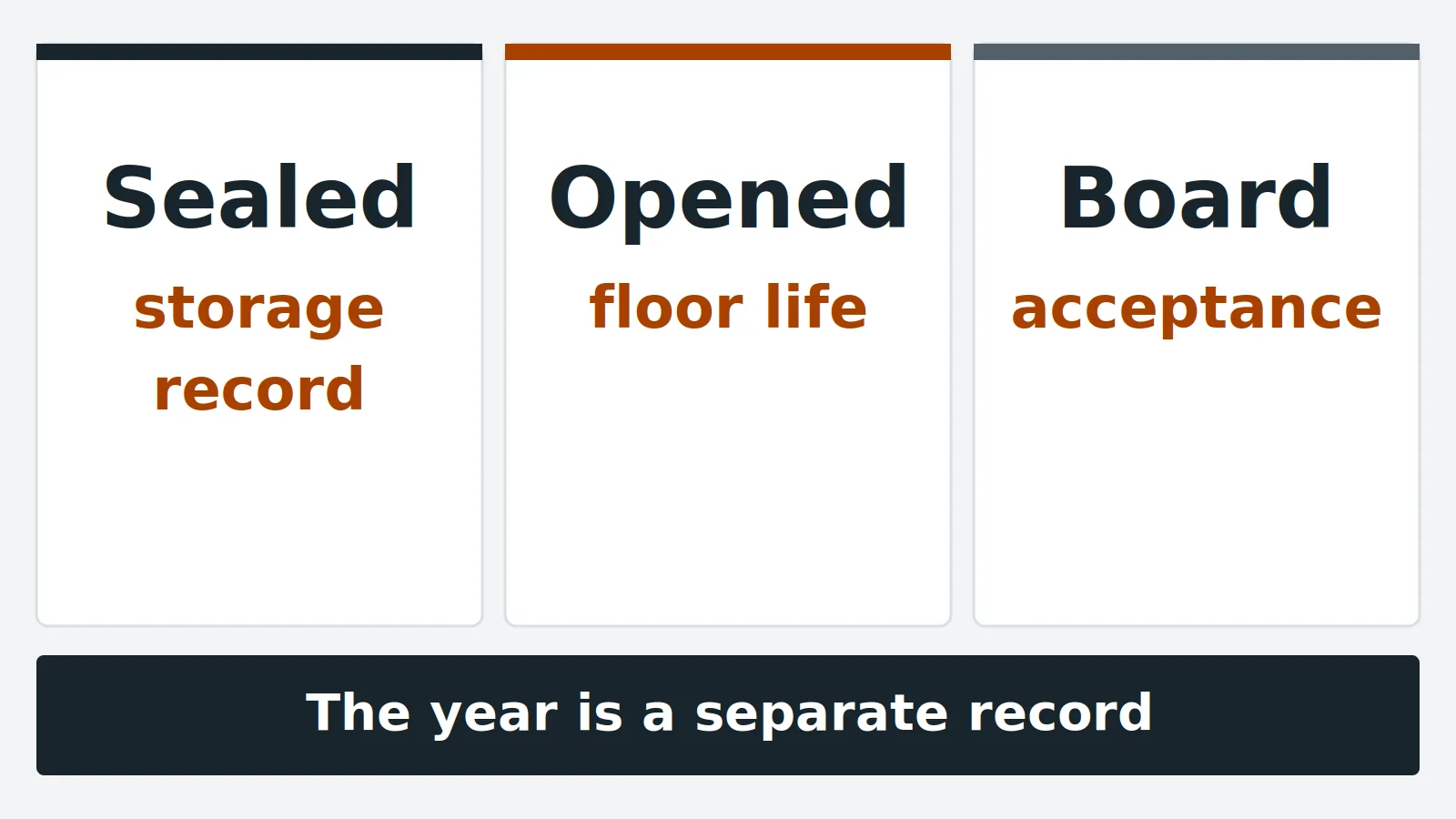
Three clocks can be open at once. A sealed bag is a storage-evidence question. An opened bag is a floor-life question. A part already soldered to a board is an acceptance question about that board. Each clock has its own document and its own approver.
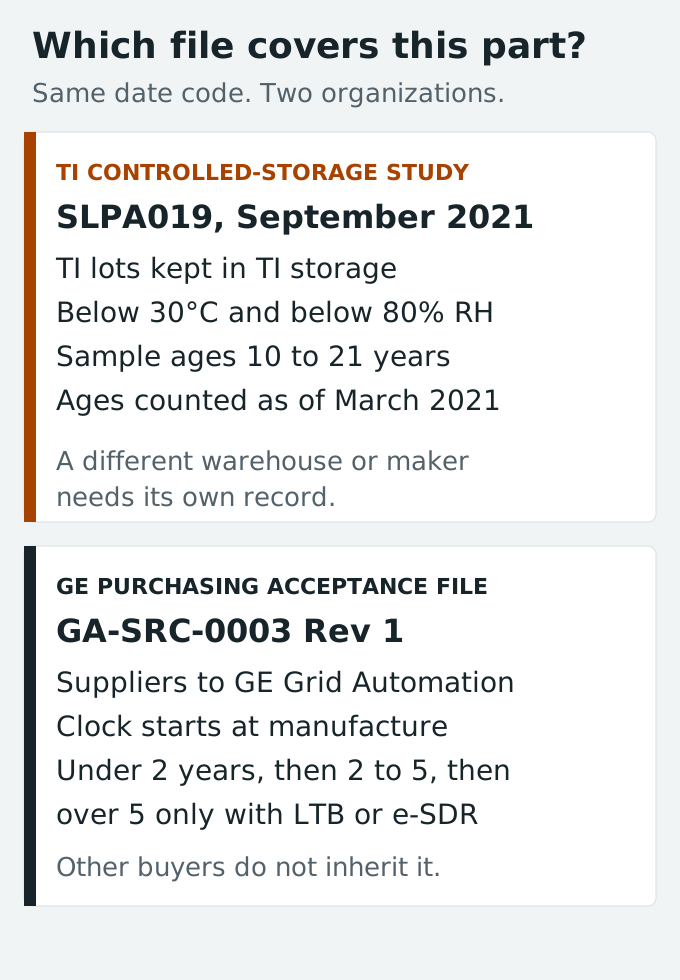
| File | Who it speaks for | Clock it uses | What stays outside it |
|---|---|---|---|
| TI product shelf-life page, and SLPA019 (September 2021) | TI, about TI products and the controlled storage in that study | Useful life from delivery to the customer; study ages counted inside TI storage | Another manufacturer’s part, or a warehouse TI did not control |
| GA-SRC-0003 Rev 1 | Suppliers to GE Grid Automation | Years from the date of manufacture, as acceptance gates | A physical failure age for every IC, or a buyer who has not adopted this file |
Match the file to the organization it names
TI’s controlled-storage study
SLPA019, September 2021, evaluates semiconductor devices after long storage. The procedure says 56 lots were stored in a controlled environment below 30°C and below 80% relative humidity. Ages in that set ran from 10 years to 21 years, determined as of March 2021. Samples S1 through S9 had remained in TI’s Singapore Product Distribution Center and were retested for the paper. The summary says reliability was assessed for devices stored in an environmentally controlled warehouse for up to 21 years, and that no failure mechanisms were identified. It also says the desiccant used for moisture-sensitive product in the study was active for more than 15 years, and that humidity-indicator cards from those bags were still functional.
The abstract says the data show that products properly stored in a controlled environment “can be stored significantly greater than 15 years.” The procedure names the environment used for these lots: below 30°C and below 80% relative humidity. The lots were TI product. The packaging section says the samples were retrieved from storage warehouses and shipped to the evaluating TI reliability lab. A reel in another warehouse, or a device from another manufacturer, is outside that sample set. The 21-year figure is the oldest age in the assessed set as of March 2021. It is a study result for those lots, and a receiving stamp for a different reel needs a different record.
TI’s product shelf-life page draws a related line for TI products. The minimum useful life is based on the date of delivery to the customer, not the manufacturing date. The page says TI’s manufacturing date code has no impact on usage, quality, or reliability of TI products under TI’s manufacturing and distribution controls. Customer shelf life is the time the customer can store the product after delivery. That time follows from the materials, the moisture-sensitivity level, the moisture-barrier bag, the desiccant, and the customer’s storage. The page points to the moisture-sensitivity information on the bag or box for the acceptable length of environmental exposure. If the humidity-indicator card shows pink at the level marked greater than 10%, the parts in that bag need baking before use. The bake schedule is the one named by the bag and the handling standard. This page does not give a bake time or temperature.
The paper’s conclusion says that, on the basis of these studies, TI will eliminate limitations on storage durations and will keep collecting data. That sentence is TI’s statement about TI storage policy. It does not move the sample set into a customer’s warehouse.
The paper’s background states that before 1995, MIL-PRF-19500M required electrical retest after a three-year date-code window, and that the 1995 revision removed that requirement. The same background cites a 2002 NEDA publication recommending that date-code age restrictions be removed from orders. Those sentences are a reason to look up the rule that actually applies. They are not a three-year failure life for an IC on the shelf today.
Takeaway: Use SLPA019 for the TI lots and the controlled storage the paper names. Keep another warehouse, and any non-TI part, on a separate record.
GE Grid Automation’s purchasing file
GA-SRC-0003 Revision 1 is a supplier requirement for the GE Grid Automation division of GE Grid Solutions. The copy read here is the PDF hosted on GE Vernova’s April 2025 file path. The revision chart dates Revision 1.0 at November 26, 2021. Each page is marked uncontrolled when printed. Section 3 says the times are referenced from the date of manufacture. The purpose section says the original component manufacturer’s recommendations are taken into consideration for final justification where appropriate.
For active components, including semiconductors, oscillators, and diodes, the file says they can be accepted if less than 2 years old. Between 2 and 5 years old, they must pass a solderability test, which the file names as J-STD-002A and J-STD-003b. If they are more than 5 years old, they cannot be used unless the use is a last-time buy or is approved via e-SDR.
Unless otherwise noted, the file’s storage condition is 18–30°C and less than 70% relative humidity, in original factory-sealed packaging or in resealed bags that follow the applicable ESD and moisture-sensitive handling procedures.
Those ages are acceptance gates for suppliers shipping into that division. They are purchasing rules in that file. A purchase that is not under this file does not inherit the gates. Inside this file, the path for an active part older than 5 years is the e-SDR approval the document names, not a receiving decision based on the year alone.
Section 3.7 says a finished PCBA can be used up to 5 years if there is no evidence of corrosion. That line is about boards supplied under this document. It does not convert an IC’s open-bag floor life into a board life, and it does not set a 5-year life for every assembled board.
Section 4 says moisture-sensitive component floor life shall follow J-STD-033b for floor-life classification and for reflow and bake procedures. The file does not print floor-life hours. Its bake table for bare printed boards, by finish, stays in that board section. This page does not copy it as an IC bake.
The same file gives wet aluminum electrolytic capacitors a different age from semiconductors: less than 1 year from the component manufacture date up to the ship date to GE, with a separate approval path after that. Even inside one purchasing file, the semiconductor lines and the capacitor lines are different records.
Takeaway: Apply the 2-year and 5-year lines only when GA-SRC-0003 is the acceptance document for this purchase, and send an over-5-year active part down the e-SDR path that file names.
Split the sealed bag, the opened bag, and the board
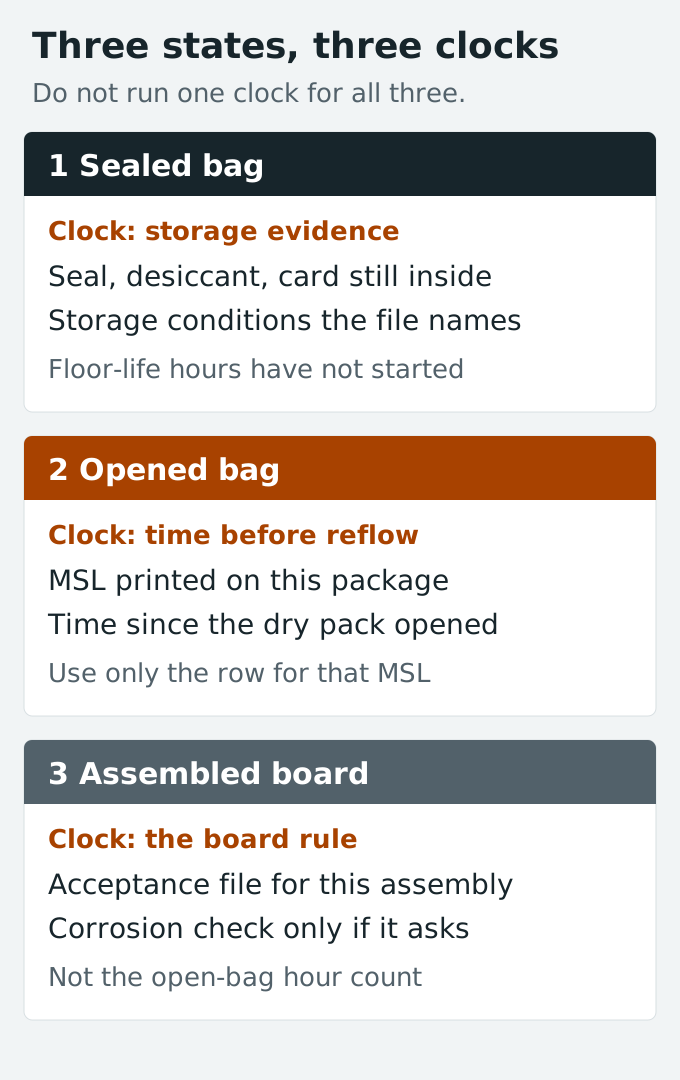
A sealed bag has not started the floor-life clock defined in SLVA840. That January 2017 application report says floor life is the time a device can be out of its dry pack before it is reflowed. Until the bag is opened, the questions are whether the seal, desiccant, and humidity card are intact, and whether storage matches the conditions the applicable document states. TI’s shelf-life page tells the customer to read the moisture-sensitivity instructions on the TI bag or box. When GA-SRC-0003 applies, it asks for original sealed packaging or a conforming reseal, at 18–30°C and under 70% relative humidity.
An opened bag is a different record. The moisture-sensitivity level printed on that package selects a row. The level is read from the label. It is not guessed from the part number. SLVA840 Table 1, Factory Floor Life at 30°C, reproduces IPC/JEDEC J-STD-033C for TI power modules. In that printed table, MSL 1 sits in its own humidity cell at 85% RH. One 60% RH cell covers MSL 2, 2a, 3, 4, 5, and 5a, and the cell continues through the MSL 6 row.
| MSL on the label | Floor life at 30°C in SLVA840 Table 1 | Humidity cell in that table |
|---|---|---|
| 1 | Unlimited | 85% RH, its own cell |
| 2 | 1 year | 60% RH, shared cell |
| 2a | 4 weeks | 60% RH, shared cell |
| 3 | 168 hours | 60% RH, shared cell |
| 4 | 72 hours | 60% RH, shared cell |
| 5 | 48 hours | 60% RH, shared cell |
| 5a | 24 hours | 60% RH, shared cell |
| 6 | Bake before use, and reflow within the time on the label | 60% RH cell continues through this row |
The report says most TI power modules are rated MSL 3 or higher, and that those ratings assume a constant 30°C and 60% relative humidity. Higher humidity or a higher temperature can shorten floor life. SLVA840 points to the Recommended Equivalent Total Floor Life table in J-STD-033C for other temperatures from 20°C to 35°C and relative humidity from 5% to 95%, for different package types and thicknesses. This page does not copy the cells of that second table.
If floor life is exceeded, SLVA840 says the device must be baked before reflow and tells the reader to consult J-STD-033C for bake time based on package thickness, moisture-sensitivity level, and bake temperature. It also says devices in tape and reel, trays, or tubes may not be baked above 40°C. That is a limit on those carriers. It is not a bake schedule. A reel without its label does not get a time and temperature invented here.
A part already soldered to a board is a third record. Floor life in SLVA840 is the time before reflow. After that reflow, the open question is the acceptance rule for the assembly. If the purchase is under GA-SRC-0003, the finished-PCBA line is the 5-year check for evidence of corrosion, and only for boards supplied under that file. Another customer’s board rule is read from that customer’s specification.
Takeaway: Write three lines on the receiving record: sealed-bag evidence, opened-bag exposure against the label’s level, and the board rule if the part is already assembled. Leave a blank line blank.
STM32L072 has no shelf-life number in the public thread
A March 18, 2022 thread on the ST community asks for the shelf life of STM32L072. The replies posted that day do not give a year or an hour. One reply says the answer depends on where and how the part was packaged, and tells the reader to check the moisture-sensitivity label, check the moisture cards, and bake when needed. Another reply says shelf life is not a standard specification on chips, that storage decides how long they last, and that it is generally not an issue. That reply links an ST soldering application note. This page does not take a shelf-life figure from that note.
An STM32L072 reel is handled like any other part whose label level is still unread. Read the level on the bag in hand. If the level is absent, the floor-life table has no row to apply. TI’s power-module hours and GE Grid Automation’s supplier ages do not transfer to this ST part. Package and operating-condition claims from a datasheet stay in the microcontroller datasheet checklist, separate from this storage record. The customer’s acceptance file, when it names an age, is the acceptance rule. The forum thread is not an approval.
A DigiKey forum note from August 12, 2020 says the shelf life of then-current aluminum electrolytic capacitors is approximately 2 years and depends on storage temperature, pressure, and humidity. That note is about those capacitors. It is not an IC shelf life, and it is not an STM32L072 figure.
Takeaway: For STM32L072, record the bag label and the customer’s specification. Leave the shelf-life field empty when neither document states a number.
Hand each document to the person who can approve it
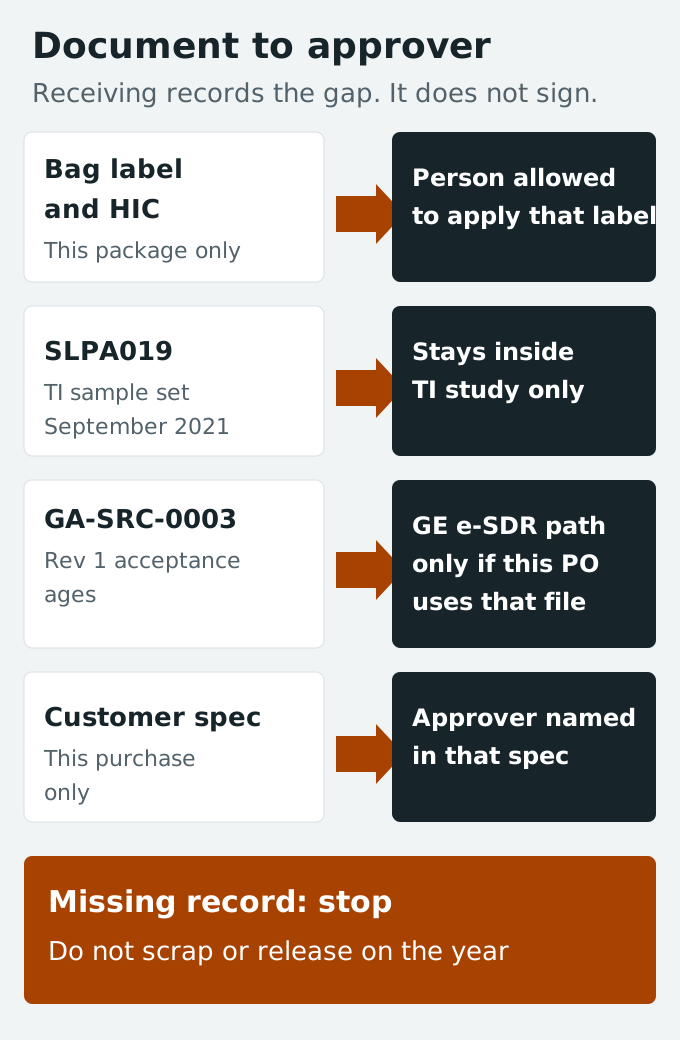
Receiving can collect the documents. Receiving does not become the approver because a year looks old or looks recent. The approver is the party the applicable document names.
| Document in hand | What it can support | Who approves, and for which parts | If it is missing |
|---|---|---|---|
| Date marking plus the manufacturer’s marking rule | A production-period reading for that marking | The person who owns the marking rule can confirm the reading. That confirmation is not a shelf-life approval. | Do not invent a calendar age. Do not scrap or release from the unread code. |
| TI product shelf-life page | For TI products: useful life counted from delivery; TI’s date code is not a usage limit under TI’s own controls; pink at the card’s greater-than-10% spot means bake before use | TI’s statement covers TI products. It does not appoint the reader’s warehouse as a TI approver. | A non-TI part has no TI shelf-life statement to borrow. |
| SLPA019, September 2021 | Study results for the TI lots and the controlled storage the paper describes, including ages of 10 to 21 years as of March 2021 | The conclusion stays with that study. | A local warehouse log does not inherit the 21-year result. |
| This package’s moisture-sensitivity label and humidity card | The level and the card reading on this bag | The person allowed to apply that label’s instruction | Do not pick a level, a floor-life hour, or a bake from a neighboring part. |
| SLVA840 Table 1, January 2017 | Floor-life hours at 30°C for the level on a TI power module, as that report prints J-STD-033C | Use the row that matches the label. The report’s “MSL 3 or higher” sentence is about most TI power modules. | Without a label level, the hour column stays unused. |
| GA-SRC-0003 Rev 1 | Supplier acceptance ages for GE Grid Automation, from the manufacture date: under 2 years; solderability test from 2 to 5 years; over 5 years only for last-time buy or e-SDR | The e-SDR path the file names, and only when this purchase is under that file | If the customer is not that division, the 2-year and 5-year lines are not this receipt’s rule. |
| The customer’s purchase or quality specification | The acceptance terms for this receipt | The approver named in that customer’s process | The year cannot be turned into scrap or release. |
| ST community thread, March 18, 2022 | Evidence that the public thread states no STM32L072 shelf-life number | No one. A forum reply is not a release signature. | The bag label and the customer specification remain the open records. |
Takeaway: The approver is the party the applicable document names. A missing name means the decision stays open.
Close the record without using the year as a verdict
List the gaps in ordinary language:
- No manufacturer rule for the date marking.
- No statement of where this reel was stored, or the statement describes a different organization from the one that stored it.
- The bag is open, and the moisture-sensitivity label or the time since opening is absent.
- The humidity card was not read, or it shows the pink condition TI’s page flags at the greater-than-10% level, and the applicable bake instruction has not been identified.
- The customer’s acceptance file is not in the packet, so GE’s ages and TI’s study cannot stand in for it.
- The part is an STM32L072, or any other device, and neither the label nor the customer’s file states a shelf-life number.
Hold the material as unresolved while those lines are open. A complete record can still end in a hold when the named approver has not signed. Scrap and release are that approver’s actions, made against the file that applies, with the three state lines filled or marked not applicable. Continue through sourcing review with the open line still visible.
Common mistake: Scrapping a reel because the date code’s year is old, or releasing it because a storage study discusses many years.
Takeaway: The year stays in the date field. The decision waits on the missing record and the named approver.
When this does not apply
This page does not decode date codes, choose a substitute part, or set a bake schedule. It does not inspect a named lot. The diagrams are schematics, not photographs of a received reel. It does not turn a forum reply into a manufacturer specification. A quality decision uses the purchase requirements and the authorized process for that purchase.
Takeaway: Keep the shelf-life question attached to the document that governs this part.
Methods and sources
The statements above were checked against copies retrieved on October 11, 2026: TI’s product shelf-life page; TI white paper SLPA019, September 2021; TI application report SLVA840, January 2017; the GE Vernova PDF GA-SRC-0003 Rev 1, with Revision 1.0 dated November 26, 2021; the ST community thread dated March 18, 2022; and a DigiKey forum post dated August 12, 2020, used only to keep an electrolytic-capacitor remark off IC decisions. No lot was inspected for this article. SLVA840’s second floor-life table, for other temperatures and humidity, was not copied because its cells were not read. The ST soldering note linked from the forum was not used as a number source.
Related reading
- Date codes and traceability — Record the marking before anyone treats the year as a life limit.
- Microcontroller datasheet checklist — Keep package and operating conditions in their own source-linked record.
- Sourcing evidence route — Keep purchase documents beside the storage and floor-life lines.